
Improve SEO or Search Engine Optimization
Want to improve SEO on your website and generate more traffic, for free? Get found more easily by search engines like Google? What about being referred to by users on YouTube, ChatGPT, or Claude?
Optimizing your website to be found in search and by AI tools is probably one of the easiest DIY digital marketing tips we can teach you today! With so much competition in the outdoor recreation, travel, and lifestyle industries, improving your SEO will increase brand awareness and community engagement. Let’s get started with a quick review of SEO!
What is SEO?
First things first, to improve SEO, you need to understand what it is.
Search Engine Optimization or SEO means designing or optimizing your website to be found easily by search engines, YouTube, or AI applications like ChatGPT and Claude, through natural, unpaid, or organic means. The goal here is to boost traffic to your website. And without paying for it.
Search engines like Google, Bing, and Yahoo run billions of searches for people each day, often in a matter of milliseconds. Add in ChatGPT, Claude, and even searches that begin on YouTube, and you can see how important being discoverable can be for your business!
So, how can you help these searchers find your products or services? How do you land on the first page of Google or be mentioned by ChatGPT?
Of course, you can set up and run Google Ads to try and buy your way into those top spots. If you have an interest in learning how to run Google Ads, check out our DIY Guide to Google Ads! However, since we’ve managed SEO strategy for several clients without running ads, here are our top 10 SEO Best Practices!
Top 10 Ways to Improve SEO and Get Free Web Traffic
1. Install an SEO Tool on your website! Our favorite tool to improve SEO for a WordPress website is either Rank Math or Yoast SEO. Plus there are free versions of both Rank Math and Yoast that are super easy to use!
Not on WordPress? Use built-in SEO tools on Squarespace and Wix!
2. Select a Keyword or Keyphrase for each page on your website. An example of this is below!
3. Update your SEO Title tag to include the keyword or key phrase.
4. Use Headings or Heading tags (H1, H2, H3…) that contain your keyword or keyphrase.
5. Ensure your key phrase is in the introductory paragraph! Use variations of your key phrase throughout your content.
6. Update your slug or URL to include that keyword or keyphrase.
7. Add internal and external links to related content that supports your keyword or keyphrase.
8. Update the Meta description to include the keyword or keyphrase.
9. Add ALT tags and image descriptions that contain your keyword or keyphrase.
10. Ensure your keyword or key phrase is different for each page, product, or blog.
If some of these tips to improve SEO do not sound familiar, or you are unsure where to find them on your website, drop us a line, and let’s see if we can help. Now let’s dive deeper into examples of keywords and key phrases below!

Help people find you through search engines by improving SEO across your website- whether its a Squarespace, WordPress, Shopify or Wix website.
Improve SEO with Focused Keyphrases
The biggest way to improve SEO on your website, generate free web traffic, and become more discoverable is to identify the best keyword or key phrase for each page. Whether this is your blog page, services page, product page, or the about us page. How can people find your products or services if you don’t turn up in search?
Therefore, each page of your website must have a keyword or keyphrase to help readers find your content through organic search on Google Gemini, ChatGPT, Claude, or on YouTube.
SEO Keyphrase Example
Okay great, so you know what SEO is, and what a keyword or keyphrase is, but you are unsure how to select the right keyword or keyphrase. As an example, let’s say you choose ‘San Diego outdoor activities’ as your key phrase. This might be something we’d use for our Top 8 Summer Activities in San Diego blog!
But, how then do we weave this key phase into our content? Do we just repeat’ San Diego outdoor activities’ through our blog post?
In truth, keyword or keyword phrase density is not the complete answer. Repeating your keywords a dozen times throughout your blog post or webpage is not the best way to get your content ranked.
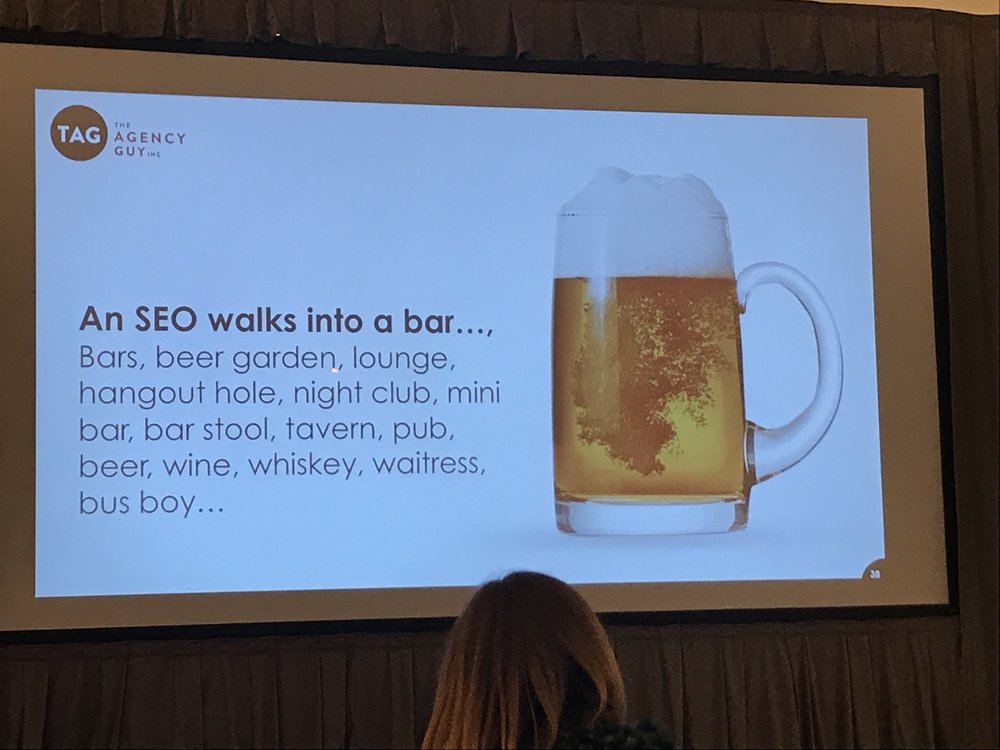
My favorite slide from ‘The Agency Guy’ gives you a hint as to what keywords or keyphrases might be used for a ‘bar’.
Keyphrase Ranking in Search Engine Results Pages (SERPs) and AI Tools
Google, Bing, and Yahoo use topic modeling and semantically relevant terms to return your SERPs (search engine results pages). In addition, ChatGPT and Claude act as conversational engines and autonomous research assistants.
Showing up in search and being referred to by AI tools requires a mix of:
-
- variations of your keywords or synonyms
- context of search
- perceived user intent
- your current location
- natural, conversational queries
- long-tail keywords
Back to our keyword or keyphrase example: San Diego outdoor activities. Google and ChatGPT know that the search entries and prompts below are all related to San Diego outdoor activities:
- Things to do in San Diego
- San Diego adventures
- Best outdoor activities near me (if you’re in the area)
- San Diego family-friendly activities
- Free activities in San Diego
- San Diego Zoo
So, we’ve included all of these terms and more in our Top 8 Summer Activities in San Diego blog! Instead of keyword density alone, use relevant terms to boost your website content!

Build your client base and be more discoverable by Google Gemini, ChatGPT, and YouTube by improving your SEO.
Improve SEO: Resources That Can Help
Struggling to identify the best keywords or keyphrases for your blog, services, or products? Or how to optimize your website to be found in search and referred to by ChatGPT or Claude?
Add the Rank Math or Yoast SEO plug-in. In addition, there are several other SEO tools you can use:
More Help to Improve SEO and Get Free Web Traffic
Want more help to improve SEO and generate more website traffic? We’ve written DIY blogs and case studies to help you increase traffic and create more brand awareness!
- How to Use Your Website to Generate Better Leads
- Easy Website Design + Maintenance
- Case Study: Web Design for Outdoor Outreach
- Case Study: Website Design for Rochelle Ballard, Online Surf Coaching
Until next time, take a few steps today to improve that SEO and get more traffic to your website for free!
Meredith McConvill, Top Rope Media
Awesome summary. Glad you liked our website workshop!
Thanks,
Monica Moon
Interactive Creative Director | Elevated.com
Thanks so much Monica. Our entire table wished it was longer! You should definitely consider hosting a workshop at Elevated.